
By 2024, Karl Bushby had been walking around the world for 26 years — and the world had run out of road for him. Ahead lay the Caspian Sea, the largest inland body of water on the planet. South of it: Iran, which had refused him entry. North of it: Russia, closed and dangerous for a British passport. The borders around it were sealed by a pandemic's long tail and a war. Every land route home was shut. So the walker did the one thing left on the map. He got in the water — a man who describes himself as a terrible swimmer — and swam across an entire sea.
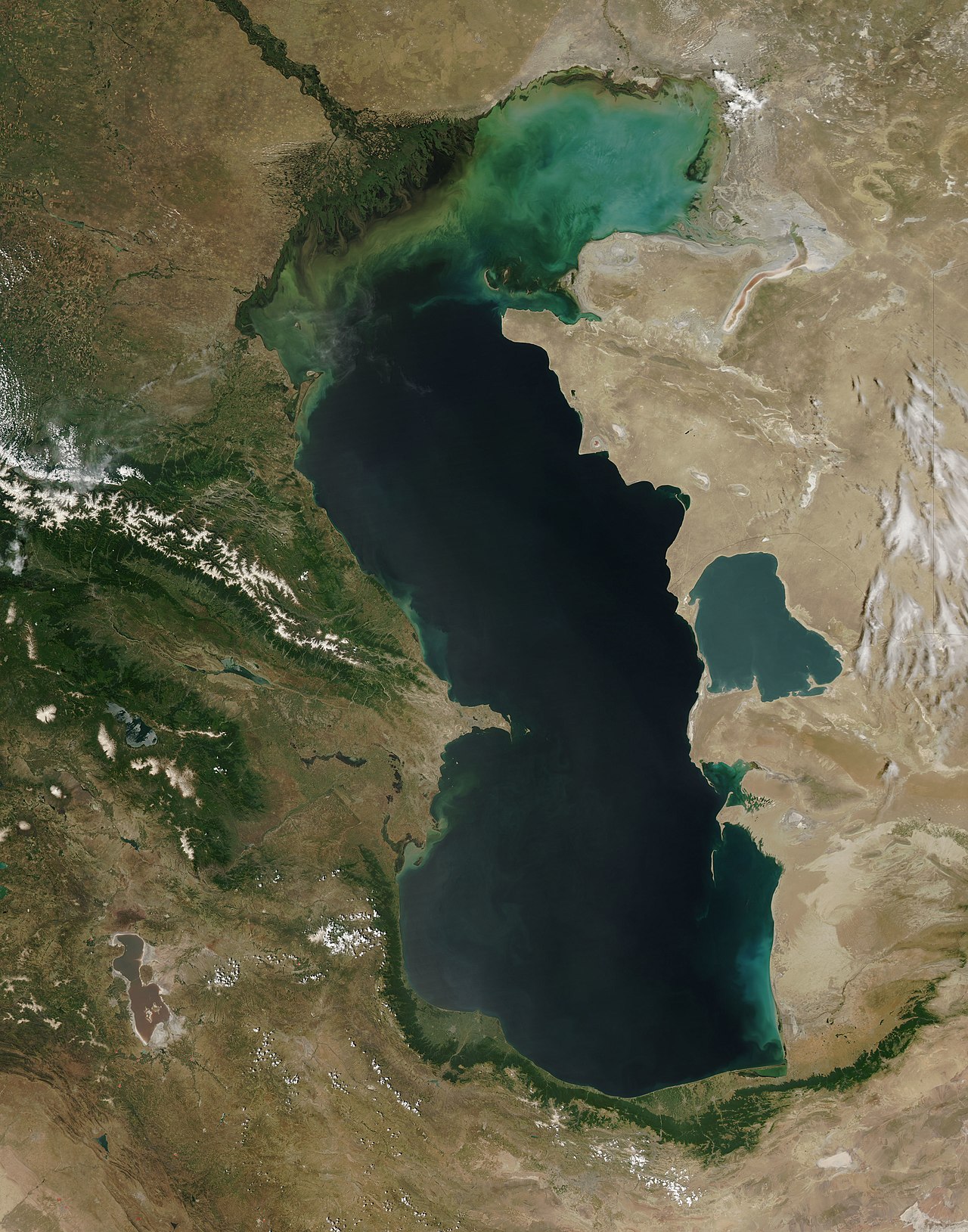
The Caspian Sea from orbit (NASA Terra satellite). The crossing ran from the Kazakh shore (right) to Azerbaijan (left). Photo: Jeff Schmaltz, MODIS Rapid Response Team, NASA/GSFC (public domain), via Wikimedia Commons.
The map ran out of land
Understand the trap. Bushby's expedition, begun in Punta Arenas, Chile, in November 1998, ran on one rule: an unbroken line around the planet, powered only by his own body. No vehicle could ever carry him forward. That rule had already taken him across the frozen Bering Strait on foot. It now left him in Central Asia with three doors, and all three were locked.
Iran was the planned route, and it failed in stages: sanctions stopped his sponsors' money reaching him, a visa was refused outright, tensions after the killing of General Soleimani hardened the border, and the pandemic sealed Turkmenistan's frontier too. Russia, his other way west, was closed by the war in Ukraine and too dangerous to enter on a British passport. The years in between — long stretches based in Mexico, the walk frozen — were the tax this expedition kept paying to geopolitics. When he finally moved again, walking the Kyzylkum Desert of Uzbekistan with fellow adventurer Angela Maxwell, he reached the Caspian's eastern shore and stopped. Water is where walking ends. It was not where his rule ended.
Plan C was the water
The logic was the same logic that had carried him across the ice of the Bering Strait: the sea was not an excuse, it was a surface. He could not walk around the Caspian, so he would cross it the only way his body allowed — through it. The fact that he could barely swim was, in this expedition's arithmetic, a detail. He had walked 31,000 miles. Swimming was simply the next skill the route demanded, learned the way he had learned everything else on this journey: badly, in public, for a very long time.
He did not go alone. Maxwell, who had trekked with him across the Gobi and the steppe, swam beside him. So did two Azerbaijani national swimmers, Anastasia Boborykina and Abdurrahman Rustamov. Support boats shadowed the team. And Bushby, in a wetsuit and flotation gear, developed a technique he called "floatimming" — part swimming, part floating, inelegant and effective. It is believed to be the first swim crossing of the Caspian Sea. It was certainly the first one attempted as a commute.
Six hours a day, thirty-one days
The swim began in August 2024, from the coast of Kazakhstan, aimed at Azerbaijan: 288 kilometres — 179 miles — of open, choppy water. The rhythm never varied. Two sessions a day, three hours in the morning and three in the afternoon. At night the swimmers slept on the support boats. That sounds like a loophole, until you hear the discipline that governed it: every morning, the boats carried them back to the exact coordinates where they had climbed out the evening before. The boats could shelter and feed them — but were never allowed to move the line one metre forward. The chain of his own effort had to stay unbroken, on water exactly as on land.
Thirty-one days of that rhythm. One hundred and thirty-two hours in the water. A poor swimmer, crossing the largest lake on Earth at the speed of a slow walk, through weather that turned the surface rough and unkind. In October 2024 the team reached the Azerbaijani shore. The sea drawn on his map as a wall was now behind him, crossed the way he had crossed everything since 1998: personally.
The line held
From Baku he simply started walking again — through Azerbaijan and Georgia, into Turkey, and on May 2, 2025, across the Bosphorus Bridge into Europe. Eighteen months later he walked through his mother's front door in Hull, and the 28-year line closed. The Caspian is the purest version of his whole method. The jungle had no road, so he walked through the jungle. The ocean froze, so he walked on the ocean. The sea would not freeze, the borders would not open, and the road simply ended — so he floated across 288 kilometres of water, six hours a day, until the far shore arrived. At no point in 28 years did Karl Bushby ask the world to make an exception for him. He just kept adapting his body to whatever the map demanded next. That is not stubbornness. That is the discipline underneath it: the line is the point, and the line does not break.
Frequently Asked Questions
When did Karl Bushby swim the Caspian Sea? The swim began in August 2024 and finished in October 2024 — 288 kilometres (179 miles) from Kazakhstan to Azerbaijan, completed in 31 days with 132 hours spent in the water.
Why didn't he just walk around it? Every land route was closed to him: Iran had refused him a visa, Russia was judged too dangerous for a British passport during the war in Ukraine, and pandemic-era closures had sealed the alternatives. His rule — an unbroken, self-powered line — ruled out flying or sailing around it.
Who swam with him? Angela Maxwell, his long-time expedition partner, and two Azerbaijani national swimmers, Anastasia Boborykina and Abdurrahman Rustamov, with support boats alongside. Each morning the team re-entered the water at the exact coordinates where they had left it, so the boats never advanced his route.
Was he a strong swimmer? No — by his own account he was a poor one. Wearing a wetsuit and flotation gear, he used a hybrid of swimming and floating that he called "floatimming".
The rest of the Karl Bushby story
One man, one rule — never let a vehicle carry him forward — and 28 years of consequences. Read the whole series:
- The Beast: the homemade cart that carried him home
- He walked across an ocean: the Bering Strait
- Home at 57: the granddaughter he had never met
Bushby crossed seas on foot and by swim, but some islands only exist on paper first — as a row in a spreadsheet, a name you keep coming back to. One of those names is the island in the spreadsheet, and the story of how it got there is stranger than the swim.
0 comments